Woah, I remember this thing. It's been months, since July I think...I have lots to say, but I'm not going to say it. Instead, watch this:
Manhatta
What do you have to say about it?
11.16.2006


7.26.2006
Back in Action
It’s been five months, but I’ve returned. That means I’ve been away for longer than the blog has been active…which means I’m probably just writing to myself, as the few people who knew about YU Blog?! have likely stopped checking for updates by now. I can’t even validate the claim of “A Yeshiva University Student Blog-Bringing Wisdom to the Web”, as I’ve graduated, and I’m thus no longer a Yeshiva University student.
Then again, half of this blog’s active life took place after I stopped taking classes at YU. And I still work at YU, which gives me some claim to write the YU Blog?! Maybe now the question mark and exclamation mark make more sense. When people hear I write a YU blog, they’ll respond with, “You write the YU Blog?!”
Most of those who read this will know why I’ve been gone for so long. For those of you who don’t, check back after a few posts. A lot’s happened in since March and I’m still getting my feet under me. Once YU Blog?! is up and fully running, I’ll tell you all the harrowing tale.
For now I’ll say I’ve moved to the other side of the Heights, where I’ve found a piece of real New York City living. I’ve enjoyed the city ever since I moved here, but never as much as I have for the past few months. Across the street from the A train, respectable bars with live music on the weekends, organic grocery stores and gourmet wine shops all within walking distance. I never minded living on the YU side, until I moved out and realized what I was missing.
I’ve also made another great discovery-my bike. I lived with that thing under my dorm room bed for the first two years of college. I would make it out a few times a year, but I never utilized it as a valid means of transportation. Now it takes me 20 minutes to get to Central Park. It takes less than an hour to get to Battery Park. The island has shrunk significantly.
I’ll write more about my bike some other time, there’s just too much to say to fit in this post. For now, I just wanted everybody (nobody?) to know I’m still here.
Let me know if any of you are still out there.
2.28.2006
The Noble Coffee that Was
I’ve been debating whether or not to tell this story, but I’ve decided its something I must share.
After a struggle trying to decide what to have for dinner the other night, I settled on frozen steak from the kosher store on Amsterdam. As I ate this perfect meal of beef and potatoes, I got a call from the team. They wanted to go to the Village.
As it neared time for the shuttle, I stopped by the library for warmth. I noticed the random café there was open, so I went to buy a coffee. The lady told me regular coffee cost a dollar, whereas flavored cost $1.10. From behind the cashier, she could not see the two urns, so I asked her how she knew what people were buying. She said she only knew what they told her…
After pouring myself a regular cup and filing it with two packs of sugar and some whole milk (instead of the skim, which was also available), I moved the perilously full cup to the register. My phone rang at the same time I reached for my wallet, so I used each hand to remove them both from my pockets. Somehow, in the chaos, the coffee cup exploded.
Light brown coffee spilled over the counter, into the napkin dispenser, under the register. A small coffee lake formed at my feet. All in a matter of seconds.
As I rushed to help the lady clean up the mess, I worried about missing the shuttle. Subways alone are boring. We worked together to contain the flood and I sheepishly asked her for a free refill, to which she agreed.
My new cup in hand, I boarded the shuttle and sat down to enjoy my hard earned drink. As I took my first sip, I smelled the milk and realized I had eaten meat not 45 minutes before. I suddenly knew why the first cup committed suicide. It was to save me from eating milk after meat.
I didn’t want to sit with a full cup of coffee the whole way down to Stern, so I stood up and asked the full shuttle if anyone wanted some coffee. A girl in the back asked if it was caffeinated, which I thought was kind of a dumb question. “Very,” I said, and turned around to offer the drink to the driver. He looked at me as if I was offering him a bribe or something, so I changed my offer to, “Would you at least throw it out.”
He did, and my ride down was uneventful. The events to follow have their own tale to tell. But when I think back on that night, I can’t help but to reflect on that poor cup that gave its life to better my own.
After a struggle trying to decide what to have for dinner the other night, I settled on frozen steak from the kosher store on Amsterdam. As I ate this perfect meal of beef and potatoes, I got a call from the team. They wanted to go to the Village.
As it neared time for the shuttle, I stopped by the library for warmth. I noticed the random café there was open, so I went to buy a coffee. The lady told me regular coffee cost a dollar, whereas flavored cost $1.10. From behind the cashier, she could not see the two urns, so I asked her how she knew what people were buying. She said she only knew what they told her…
After pouring myself a regular cup and filing it with two packs of sugar and some whole milk (instead of the skim, which was also available), I moved the perilously full cup to the register. My phone rang at the same time I reached for my wallet, so I used each hand to remove them both from my pockets. Somehow, in the chaos, the coffee cup exploded.
Light brown coffee spilled over the counter, into the napkin dispenser, under the register. A small coffee lake formed at my feet. All in a matter of seconds.
As I rushed to help the lady clean up the mess, I worried about missing the shuttle. Subways alone are boring. We worked together to contain the flood and I sheepishly asked her for a free refill, to which she agreed.
My new cup in hand, I boarded the shuttle and sat down to enjoy my hard earned drink. As I took my first sip, I smelled the milk and realized I had eaten meat not 45 minutes before. I suddenly knew why the first cup committed suicide. It was to save me from eating milk after meat.
I didn’t want to sit with a full cup of coffee the whole way down to Stern, so I stood up and asked the full shuttle if anyone wanted some coffee. A girl in the back asked if it was caffeinated, which I thought was kind of a dumb question. “Very,” I said, and turned around to offer the drink to the driver. He looked at me as if I was offering him a bribe or something, so I changed my offer to, “Would you at least throw it out.”
He did, and my ride down was uneventful. The events to follow have their own tale to tell. But when I think back on that night, I can’t help but to reflect on that poor cup that gave its life to better my own.
2.20.2006
An End and a Beginning
I’d like to take a step aside (maybe forever) from my German recollections and tell everyone about two things that have come to my attention. The first is the end of an era –Dougie’s on 72 street has closed. I would have thought YU orders alone could have kept the place open, but it seems hungry YUers were not enough.
Not to worry though, the chain still has a presence in Manhattan. There is a Dougie’s Express at 74 W. 47th Street. I never went there often, but every once in a while I crave their pastrami burger. It’s good to know I can still get one in the city.
I would also like to share with everyone a book my friend Elan Mosbacher just published. Here is the official blurb:
Sticking to Israel: Israeli Society Through Bumper Stickers is a coffee table book with photographs of hundreds of political bumper stickers, graffiti, and posters, complemented by translations and related pictures. The book shares many opinions that the media rarely addresses including conflicting, politically incorrect, and humorous political and religious assertions. The book portrays Zionistic, anti-Zionistic, right wing, left wing, political party, politician specific, army, religious, Nachman, Chabad, and miscellaneous themes of bumper stickers, graffiti, and posters from around the country. Arabic and Chinese bumper stickers from Israel are also included in the book.
And here are some rave reviews:
"Sticking to Israel presents to an English-speaking audience a unique look at Israeli political culture on the ground. The book is an invaluable source of material for understanding the quotidian experience of Israelis -- how politics comes to them on the street, and how they go about expressing their views in the visual marketplace of everyday life. And besides, the images collected here are a fun reminder of the vibrancy -- and outspokenness -- of Israeli democracy."
Dr. Eric Zakim,
Asst. Professor
of Hebrew Language and Culture
At the University of Maryland.
"Sticking to Israel is an unvarnished look at life on the ground in Israel today and, while its wisdom may derive only from bumper stickers, it's helpful especially to Americans who have a hard time taking the pulse of Israel."
-Stephen J. Dubner,
New York Times Journalist and
Co-Author of Freakonomics
Finally, here is an article about the book. I’m sure Elan would be interested to hear what everyone thinks about his project. Feel free to comment about it.
Not to worry though, the chain still has a presence in Manhattan. There is a Dougie’s Express at 74 W. 47th Street. I never went there often, but every once in a while I crave their pastrami burger. It’s good to know I can still get one in the city.
I would also like to share with everyone a book my friend Elan Mosbacher just published. Here is the official blurb:
Sticking to Israel: Israeli Society Through Bumper Stickers is a coffee table book with photographs of hundreds of political bumper stickers, graffiti, and posters, complemented by translations and related pictures. The book shares many opinions that the media rarely addresses including conflicting, politically incorrect, and humorous political and religious assertions. The book portrays Zionistic, anti-Zionistic, right wing, left wing, political party, politician specific, army, religious, Nachman, Chabad, and miscellaneous themes of bumper stickers, graffiti, and posters from around the country. Arabic and Chinese bumper stickers from Israel are also included in the book.
And here are some rave reviews:
"Sticking to Israel presents to an English-speaking audience a unique look at Israeli political culture on the ground. The book is an invaluable source of material for understanding the quotidian experience of Israelis -- how politics comes to them on the street, and how they go about expressing their views in the visual marketplace of everyday life. And besides, the images collected here are a fun reminder of the vibrancy -- and outspokenness -- of Israeli democracy."
Dr. Eric Zakim,
Asst. Professor
of Hebrew Language and Culture
At the University of Maryland.
"Sticking to Israel is an unvarnished look at life on the ground in Israel today and, while its wisdom may derive only from bumper stickers, it's helpful especially to Americans who have a hard time taking the pulse of Israel."
-Stephen J. Dubner,
New York Times Journalist and
Co-Author of Freakonomics
Finally, here is an article about the book. I’m sure Elan would be interested to hear what everyone thinks about his project. Feel free to comment about it.
2.06.2006
Germany III: Sachsenhousen
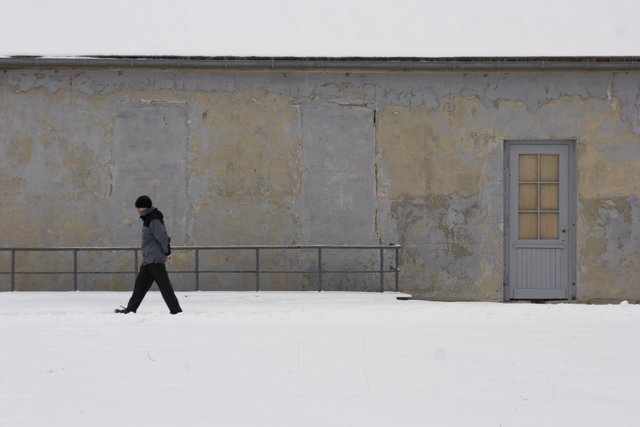
Since Blogger only seems to like one photo per post, I've decided to sum up my German recollections in one photo or less (per recollection).
This shot sums up our trip to the Sachsenhausen Concentration Camp more than any other photograph. Noah, whom I called Noaher, took a longer path than the rest of the group as we walked through this part of the camp. He appears isolated between two white voids, the first is the snow and above him is the sky.
The setting and his contemplative posture reflects how I felt that day. The terror that occurred at Sachsenhousen made me feel isolated. At the same time, I felt compelled to think hard about what it meant to be there.
I thought about how many people did not approve of a YU trip to Germany. Many people wouldn't even buy a German car…As I walked through the camp, I came to the realization that the best way to stick it to the Nazi's is to go to Germany and live as a Jew.
At first, I thought it would be hard to travel by train on German soil because of what our ancestors had to endure on German trains. But when the group davened on the train, out loud and in the open, I felt a kind of awe. Here was a group of young, Jewish students, praying out in the open in Germany. What would a Holocaust victim have said?
These thoughts reached a crescendo the day after our visit to the concentration camp. We went on a Thursday, so the next night was Shabbat. We went from the depths of tragedy to the joy of all that it means to be a Jew in just a few short hours. We openly prayed, sang and danced on the same ground where our grand and great grandparents feared for their lives.
This juxtaposition, of tragic history and hopeful present (of snowshoeing and remembering) epitomized my experience in Germany. We traveled to learn about the country's terrible past, but with an eye to its future. This made the moment in between, the present, all the more meaningful.

1.26.2006
Alps VI
 The shot of the day (one of many). Just to clarify, this photo and those below were meant for the post "Germany?! II: The Alps. For some reason, they wouldn't show up. Blogger must only like one photo per post. Sorry for the confusion, enjoy!

Alps II
" Here is the second picture. It was meant to go before the caption, "Dahlia putting on her snowshoe, but is it necessary?".
 Here is the second picture. It was meant to go before the caption, "Dahlia putting on her snowshoe, but is it necessary?".
Let's Try This Again
 I'm not sure why this didn't work, but here is the first picture I wanted to include in the last post. It was meant to go at the beginning.
Germany?! II: The Alps


The trip started light. After a 7 hour plane ride and an interesting Shabbat with the Munich Jewish community, they took us snow-shoeing in the Alps. This is a shot of the team trekking up a smaller Alp.
At first I didn’t understand the concept of a snowshoe. At the base of the mountain, where we put on the shoes, I walked around in only my regular boots and found no difficulty. I didn’t sink into a snow cave. We’ve all walked on snow before, and without the help of a crazy plastic shoe.


Dahlia putting on her snowshoe, but is it necessary?
I was going to forget the whole snowshoe business and just walk along without the cumbersome things, but I thought I’d go along for the sake of the group. Everyone was doing it, I didn’t want to be a party pooper. If you know me, you know this kind of thinking is contrary to my personality. Maybe it was the lack of oxygen way up in the Alps, or maybe it was the effect of the group starting to cohere…
Whatever the reason, by the time we started up the mountain I was happy to have the crazy plastic things around my feet. As we climbed, the snow got fluffier and deeper. Without the annoying shoes, I would have been struggling to keep up with everyone.
The snow itself was like no other snow I’ve seen before. There were two-inch chips, or crystals of snow/ice sticking out everywhere. Here’s a picture:


I asked our mountain guy:


what had caused this phenomena and he went on for five minutes in German. I then asked our German guide what he said, and she told us that the snow would evaporate at dusk when the temperature would drop suddenly. This vapor would freeze and evaporate repeatedly. The crystals of snow/ice are the result.
The high mountain air, fantastic vistas and crisp temperature shocked us out of any remaining jetlag. I felt energized. This feeling propelled me through the rigorous schedule of the rest of the trip.
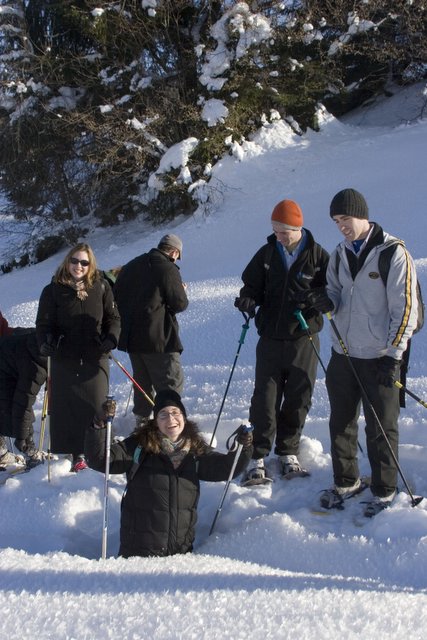
One incident on the mountain removed any doubts I may have had about the shoes. Elana Stein, our second in command, fell waist deep into a snow hole:

After I went around to take this photograph, I said to the team, “I don’t understand how that happened-” whereupon I fell into the same trench. I expected the same rush of help that Elana received, but I heard only laughter.
I eventually made it out of the hole and back down the mountain. On the train ride back to Munich I felt groggy from all the clean air and exercise. The shot of the day remained clear in my mind as I dozed off to the quiet, guttural German conversations on the train:

1.25.2006
Germany?!
Well I’m back. Most of you didn’t know I was leaving, and for that I apologize. The rest of you know that I’ve been in Germany for the past couple of weeks. I mooched another trip out of YU.
This makes three.
People ask, “Why Germany?” And I agree, it wouldn’t be my first choice for a vacation. Especially this time of year, it was so cold. I first applied for the trip because it was free. They could have sent me to the Czech Republic; I didn’t care.
I’m not choosy when someone offers me a free trip.
In retrospect, though, anywhere else would have provided only a mediocre experience. We had an amazing time, and I think it’s because Germany provided such an intense experience. Our group went to a concentration camp on Thursday, and then sang and danced in a shuel on Friday.
We snow shoed in the Alps, spoke with German Jewish college students, met with the education ministers about holocaust education, and toured Munich and Berlin. But more enjoyable than any of these activities was getting to know the group of YU and Stern students who came along for the ride.
They made the trip the incredible experience I’ll remember.
We had as much fun on a seven-hour train ride as when we did any of the other activities. At first, I thought we could have been anywhere and cohered as well. In thinking back, though, only in Germany could we have become “The A Team” and eventually, “The Gemeinda”. The intense experiences we shared were bonding.
I’m curious to know how the Honduras group fared.
Stay tuned for photos and stories. And good luck with the first days of class.
This makes three.
People ask, “Why Germany?” And I agree, it wouldn’t be my first choice for a vacation. Especially this time of year, it was so cold. I first applied for the trip because it was free. They could have sent me to the Czech Republic; I didn’t care.
I’m not choosy when someone offers me a free trip.
In retrospect, though, anywhere else would have provided only a mediocre experience. We had an amazing time, and I think it’s because Germany provided such an intense experience. Our group went to a concentration camp on Thursday, and then sang and danced in a shuel on Friday.
We snow shoed in the Alps, spoke with German Jewish college students, met with the education ministers about holocaust education, and toured Munich and Berlin. But more enjoyable than any of these activities was getting to know the group of YU and Stern students who came along for the ride.
They made the trip the incredible experience I’ll remember.
We had as much fun on a seven-hour train ride as when we did any of the other activities. At first, I thought we could have been anywhere and cohered as well. In thinking back, though, only in Germany could we have become “The A Team” and eventually, “The Gemeinda”. The intense experiences we shared were bonding.
I’m curious to know how the Honduras group fared.
Stay tuned for photos and stories. And good luck with the first days of class.
1.04.2006
The Space Inside Our Heads
We start the day in our room, generally behind closed doors. As we become more animate, we expand into other rooms of the house.
When we start out for class, the world we occupy balloons into the outdoors. Space inflates and contracts as we move throughout the day.
At the end of the day, this all happens in reverse. The expansive outdoors, the smaller world of the home, the bedroom.
We crawl into bed and eventually close our eyes. We now enter the smallest and the most expansive space of the day, the space inside our heads
We take the space of our heads with us everywhere, of course. Yet the spaces of the outside world often distract us from the tiny expanse behind our eyelids.
I once got claustrophobic from the thought that I was stuck in my own head. I think I was daydreaming during a MBP shiur at the time.
Try exploring the world behind your eyelids during the day. Sit for 20 minutes without opening your eyes (don’t fall asleep). I don’t mean “discover yourself” or anything metaphoric. Literally check out the places inside your head. I’m not sure how else to explain it.
It’s the smallest and the most expansive space of the day.
When we start out for class, the world we occupy balloons into the outdoors. Space inflates and contracts as we move throughout the day.
At the end of the day, this all happens in reverse. The expansive outdoors, the smaller world of the home, the bedroom.
We crawl into bed and eventually close our eyes. We now enter the smallest and the most expansive space of the day, the space inside our heads
We take the space of our heads with us everywhere, of course. Yet the spaces of the outside world often distract us from the tiny expanse behind our eyelids.
I once got claustrophobic from the thought that I was stuck in my own head. I think I was daydreaming during a MBP shiur at the time.
Try exploring the world behind your eyelids during the day. Sit for 20 minutes without opening your eyes (don’t fall asleep). I don’t mean “discover yourself” or anything metaphoric. Literally check out the places inside your head. I’m not sure how else to explain it.
It’s the smallest and the most expansive space of the day.
1.03.2006
Another Article
CNN.com - Gaza spirals into lawlessness - Jan 2, 2006: "It appears as if Gaza has degenerated into anarchy."
Here's another article for controversy. I look forward to hearing what everyone has to say.
Here's another article for controversy. I look forward to hearing what everyone has to say.
1.02.2006
Still Here

Just so no one forgets about YU Blog?!, here is a photo to ponder. I expect to be posting regularly again, now that I have emerged from my self-imposed, work related hibernation.
I'd like to thank the posters who took part in the previous controversy about the NY times article. I'd also like to add that my mother phoned in to comment. It is her opinion that "Cultural Judaism" has no future, because it provides no continuity for future generations. One person's definition of Judaism may work for that individual, but without the tradition of Moses to carry the religion, it will fail.
Thanks again to everyone that commented. I look forward to hering more from you in the future.
12.25.2005
Let's Try this Again
Looks like the experiment from a couple of days ago didn’t work. Here’s the article in full, I’m still interested in what you all think.
A Happy Hipster Hanukkah
By STEPHANIE ROSENBLOOM (NYT) 1775 wordsPublished: New York Times, December 15, 2005
''HELLOOOOOOOO Jews!'' the M.C. shouted to the 1,000 or so people sipping drinks and jostling elbows in the hazy purple light of Crobar, the Chelsea club, on Sunday evening. Disco balls twinkled. Electric menorahs glowed. In the candlelighted V.I.P. area, people bit into chocolate Hanukkah gelt. From a stage on the dance floor Rachel Dratch of ''Saturday Night Live'' bemoaned being Jewish at Christmastime, and Triumph the Insult Comic Dog, the foul-mouthed puppet, belted out a joyous rendition of ''Shalom Aleichem.'' It was not long before people were waving their arms above their heads and lobbing inflatable dreidels through the air like beach balls.
There was a name for this merriment: ''A Jewcy Chnukah,'' a freewheeling celebration of the holiday produced by Jewcy, a group that brings together young Jews through celebrity-filled events. (Proceeds from Sunday night went to Natan, a philanthropic organization that supports projects that engage young Jews in their religion and heritage.) At the end of the evening, which included performances by the rocker Perry Farrell and the cast of ''The 25th Annual Putnam County Spelling Bee,'' Jon Steingart, a founder of Jewcy, peered down at the packed dance floor. ''This,'' he said, ''bodes very well.''
''A Jewcy Chanukah'' is but one of many kitschy celebrations that in the past few years have made comedy as much a part of Hanukkah as latkes and sour cream. The irreverent and sometimes R-rated Hanukkah productions, popping up during what many people have called a Jewish hipster moment, are largely a reaction to what many Jews say is an overwhelming amount of Christmas hoopla. Their humor-laden productions attract thousands of young Jews (some of whom have never gravitated toward their own culture before) and, perhaps inadvertently, raise the question of what it means to be Jewish.
''We have 12 months of the year to assert our Jewish identity, so why now?'' said Rob Tannenbaum, one half of the variety show ''What I Like About Jew.'' ''The time of year that I feel most like a minority group is Christmas.''
Mr. Tannenbaum said he tries to convey his feelings to his Christian friends by asking them to imagine this: ''Everywhere you go strangers say to you, 'Merry Ramadan.' Anywhere you go you can't get into a store because people are bowing to Mecca. You'd be an angry minority. You'd be like, 'Enough of this Ramadan all ready.' ''
Christmas has gotten out of hand, said Jackie Hoffman, who is starring in ''Chanukah at Joe's Pub,'' a one-woman show. ''No one does 'The Sukkot Revue,' '' she said, referring to the autumnal Jewish holiday, ''because then we're not being badgered.''
Some Jews feel Hanukkah, which begins this year at sundown on Dec. 25, is the perfect time for comic relief because it is not a significant holiday. ''We don't do this with Yom Kippur and Rosh Hashana,'' said Joshua Neuman, the editor in chief and publisher of Heeb magazine. ''There's an added comedic value in that we know it is largely the result of American commodity culture.''
Hanukkah is a minor, generally child-centered holiday that celebrates the victory of the Jews over the Syrian Greeks around 165 B.C. No classic Hanukkah films or ballets were inspired by it. There is no ''Miracle on Hester Street,'' no ''Radio City Hanukkah Spectacular.'' Jewish songwriters have been more inclined to compose Christmas songs, including many of the most beloved: ''White Christmas'' (Irving Berlin), ''The Christmas Song: Chestnuts Roasting on an Open Fire'' (Mel Torm ) and ''We Need a Little Christmas'' (Jerry Herman), to name but three. Adam Sandler's 1995 ''Hanukkah Song,'' in which he enumerates Jewish (and semi-Jewish) celebrities, is the closest thing to a mainstream Hanukkah tune.
''I think Sandler was the catalyst for a lot of this,'' said Robert Smigel, the voice (and hand) behind Triumph, after his performance on Sunday. ''A lot of that was him asserting himself as a Jew.''
In 1997 the creators of ''South Park'' mined the potential agony of being a Jewish child during December with the lament, ''It's Hard to be a Jew on Christmas.'' By 2003 T-shirts that read ''Jewcy'' were selling like potato hot cakes, and Jewish hip-hop went from a simmer to a boil. On Monday VH1 will attempt to understand why Judaism is all the rage with a pop culture special called ''So Jewtastic.'' An excerpt from the show's press material reads, ''In an age when Madonna demands to be called 'Esther,' Jon Stewart is a sex symbol and seemingly everyone speaks a little Yiddish, it's never been hipper to be a Jew.''
Chris Mazzilli, the owner of Gotham Comedy Club, said its annual ''A Very Jewish Christmas'' is one of its most successful shows. This year he expects about 800 people, up from about 400 last year.
''For us it was a lot easier six years ago,'' Mr. Tannenbaum said. ''There was a lot less competition on Christmas Eve. It was us or the Matzo Ball. Our only competition was a bunch of pathetic Jewish singles trying to drink enough Manischewitz to forget that they were probably going to be alone on New Year's Eve.''
This year ''What I Like About Jew'' will have its largest tour ever, a six-city romp around the East Coast. ''Like most other trends,'' Mr. Tannenbaum said, ''the Jewish holiday hipster started in New York and has spread outward.''
The movement is likely to only go so far, said Rabbi Marc Gellman, part of ''The God Squad,'' an interfaith cable television show, and a Newsweek.com columnist. ''This revival is primarily a New York-L.A. thing, and it's the result of the fact that the only geographical region that has a majority of Jews outside Israel is Manhattan,'' he said. ''If you live in Wichita, the new hip Jewish movement will never reach you.''
That these Hanukkah shows tend to be the product of secular Jews also keeps the mood light.
Over the last three years more and more young Jews have been flaunting their heritage, donning T-shirts that proclaim their Semitic roots, listening to the Hasidic reggae singer Matisyahu and climbing onto the celebrity-driven kabbalah bandwagon. And though many occupy the same Lower East Side walk-ups that their grandparents once did, they are not interested in quietly assimilating. They identify more with the cultural trappings of Judaism -- the music, the cuisine, the humor -- than with the teachings of the Torah.
''We ourselves are less observant Jews, but we are still very culturally Jewish,'' Mr. Steingart of Jewcy said. The comedian Rebecca Drysdale is of like mind. ''My connection with being Jewish is not a religious one,'' she said. ''It's cultural.''
Mr. Neuman explained: ''There's this emerging sense of new Jewish culture that is self-consciously postdenominational and largely devoid of religious context.''
But those who define themselves as ''cultural'' Jews may alter their definitions over time, Rabbi Gellman said. ''When they have kids,'' he said, ''they'll say: 'What do you mean? Of course my kid will have a bar mitzvah.' '' He also pointed out that while some people call themselves ''cultural'' Jews, ''Judaism defines identity by blood, not by belief.'' Translation: If your mother is Jewish, so are you.
''I think they know very little about Judaism, but they seem to be crying out for some identity,'' said Ms. Hoffman, who has nine years of yeshiva under her belt. ''I don't know if this generation knows much about Sophie Tucker and Mort Sahl and George Jessel. I think they're just grasping for something during such an unbelievable onslaught,'' she said, referring to the Christmas season. It is good that people are grasping, she explained, but added that taking a Judaism class can be worthwhile. ''Investigate before you declare yourself a Jew in name only,'' she said. ''It's not so bad.''
Triumph the Insult Comic Dog riffed on that topic on Sunday night. ''Jewcy is the bold new movement of cool Jews,'' Triumph said, his gravelly voice dripping with sarcasm. ''Yeah, we want to be cool. We're Jews, like the Beasties! We don't want to be nerdy, like Einstein.'' Then he admonished: ''Crack open a Torah. Learn something. That's right! I'm lecturing you bitches!''
The lecture came lovingly gift wrapped in humor, but like many jokes it contained an element of truth. ''It's not just a kitschy subject matter,'' Mr. Smigel said later. ''It can be reduced to that, and that's a fear of the older generation. I feel very lucky that I got to get a real education in the religion.''
Some people do not enjoy the new Hanukkah shows. ''The older generation is often uncomfortable with our performances,'' Mr. Tannenbaum said. ''There is a sense that was common in an older generation that you shouldn't do anything that could be bad for the Jews. Don't be loud. Don't be vulgar. Don't be proud. Blend in. Assimilate. Finish college.''
During the first song in ''What I Like About Jew'' (one of the milder lyrics is ''She puts the whore in hora''), Mr. Tannenbaum said he usually hears ''a chair scraping and a pair of orthopedic shoes leaving the room.''
No such exit was made at ''A Jewcy Chanukah'' on Sunday. After two hours of music and comedy, Perry Farrell mixed the sacred and secular by singing ''Avenu Malkenu'' and ''Jane Says.'' Then he curled his string bean body over a microphone and cried, ''Happy Hanukkah!'' in a voice so joyful, he might as well have shouted, ''Happy Christmas to all, and to all a good night.''
A Happy Hipster Hanukkah
By STEPHANIE ROSENBLOOM (NYT) 1775 wordsPublished: New York Times, December 15, 2005
''HELLOOOOOOOO Jews!'' the M.C. shouted to the 1,000 or so people sipping drinks and jostling elbows in the hazy purple light of Crobar, the Chelsea club, on Sunday evening. Disco balls twinkled. Electric menorahs glowed. In the candlelighted V.I.P. area, people bit into chocolate Hanukkah gelt. From a stage on the dance floor Rachel Dratch of ''Saturday Night Live'' bemoaned being Jewish at Christmastime, and Triumph the Insult Comic Dog, the foul-mouthed puppet, belted out a joyous rendition of ''Shalom Aleichem.'' It was not long before people were waving their arms above their heads and lobbing inflatable dreidels through the air like beach balls.
There was a name for this merriment: ''A Jewcy Chnukah,'' a freewheeling celebration of the holiday produced by Jewcy, a group that brings together young Jews through celebrity-filled events. (Proceeds from Sunday night went to Natan, a philanthropic organization that supports projects that engage young Jews in their religion and heritage.) At the end of the evening, which included performances by the rocker Perry Farrell and the cast of ''The 25th Annual Putnam County Spelling Bee,'' Jon Steingart, a founder of Jewcy, peered down at the packed dance floor. ''This,'' he said, ''bodes very well.''
''A Jewcy Chanukah'' is but one of many kitschy celebrations that in the past few years have made comedy as much a part of Hanukkah as latkes and sour cream. The irreverent and sometimes R-rated Hanukkah productions, popping up during what many people have called a Jewish hipster moment, are largely a reaction to what many Jews say is an overwhelming amount of Christmas hoopla. Their humor-laden productions attract thousands of young Jews (some of whom have never gravitated toward their own culture before) and, perhaps inadvertently, raise the question of what it means to be Jewish.
''We have 12 months of the year to assert our Jewish identity, so why now?'' said Rob Tannenbaum, one half of the variety show ''What I Like About Jew.'' ''The time of year that I feel most like a minority group is Christmas.''
Mr. Tannenbaum said he tries to convey his feelings to his Christian friends by asking them to imagine this: ''Everywhere you go strangers say to you, 'Merry Ramadan.' Anywhere you go you can't get into a store because people are bowing to Mecca. You'd be an angry minority. You'd be like, 'Enough of this Ramadan all ready.' ''
Christmas has gotten out of hand, said Jackie Hoffman, who is starring in ''Chanukah at Joe's Pub,'' a one-woman show. ''No one does 'The Sukkot Revue,' '' she said, referring to the autumnal Jewish holiday, ''because then we're not being badgered.''
Some Jews feel Hanukkah, which begins this year at sundown on Dec. 25, is the perfect time for comic relief because it is not a significant holiday. ''We don't do this with Yom Kippur and Rosh Hashana,'' said Joshua Neuman, the editor in chief and publisher of Heeb magazine. ''There's an added comedic value in that we know it is largely the result of American commodity culture.''
Hanukkah is a minor, generally child-centered holiday that celebrates the victory of the Jews over the Syrian Greeks around 165 B.C. No classic Hanukkah films or ballets were inspired by it. There is no ''Miracle on Hester Street,'' no ''Radio City Hanukkah Spectacular.'' Jewish songwriters have been more inclined to compose Christmas songs, including many of the most beloved: ''White Christmas'' (Irving Berlin), ''The Christmas Song: Chestnuts Roasting on an Open Fire'' (Mel Torm ) and ''We Need a Little Christmas'' (Jerry Herman), to name but three. Adam Sandler's 1995 ''Hanukkah Song,'' in which he enumerates Jewish (and semi-Jewish) celebrities, is the closest thing to a mainstream Hanukkah tune.
''I think Sandler was the catalyst for a lot of this,'' said Robert Smigel, the voice (and hand) behind Triumph, after his performance on Sunday. ''A lot of that was him asserting himself as a Jew.''
In 1997 the creators of ''South Park'' mined the potential agony of being a Jewish child during December with the lament, ''It's Hard to be a Jew on Christmas.'' By 2003 T-shirts that read ''Jewcy'' were selling like potato hot cakes, and Jewish hip-hop went from a simmer to a boil. On Monday VH1 will attempt to understand why Judaism is all the rage with a pop culture special called ''So Jewtastic.'' An excerpt from the show's press material reads, ''In an age when Madonna demands to be called 'Esther,' Jon Stewart is a sex symbol and seemingly everyone speaks a little Yiddish, it's never been hipper to be a Jew.''
Chris Mazzilli, the owner of Gotham Comedy Club, said its annual ''A Very Jewish Christmas'' is one of its most successful shows. This year he expects about 800 people, up from about 400 last year.
''For us it was a lot easier six years ago,'' Mr. Tannenbaum said. ''There was a lot less competition on Christmas Eve. It was us or the Matzo Ball. Our only competition was a bunch of pathetic Jewish singles trying to drink enough Manischewitz to forget that they were probably going to be alone on New Year's Eve.''
This year ''What I Like About Jew'' will have its largest tour ever, a six-city romp around the East Coast. ''Like most other trends,'' Mr. Tannenbaum said, ''the Jewish holiday hipster started in New York and has spread outward.''
The movement is likely to only go so far, said Rabbi Marc Gellman, part of ''The God Squad,'' an interfaith cable television show, and a Newsweek.com columnist. ''This revival is primarily a New York-L.A. thing, and it's the result of the fact that the only geographical region that has a majority of Jews outside Israel is Manhattan,'' he said. ''If you live in Wichita, the new hip Jewish movement will never reach you.''
That these Hanukkah shows tend to be the product of secular Jews also keeps the mood light.
Over the last three years more and more young Jews have been flaunting their heritage, donning T-shirts that proclaim their Semitic roots, listening to the Hasidic reggae singer Matisyahu and climbing onto the celebrity-driven kabbalah bandwagon. And though many occupy the same Lower East Side walk-ups that their grandparents once did, they are not interested in quietly assimilating. They identify more with the cultural trappings of Judaism -- the music, the cuisine, the humor -- than with the teachings of the Torah.
''We ourselves are less observant Jews, but we are still very culturally Jewish,'' Mr. Steingart of Jewcy said. The comedian Rebecca Drysdale is of like mind. ''My connection with being Jewish is not a religious one,'' she said. ''It's cultural.''
Mr. Neuman explained: ''There's this emerging sense of new Jewish culture that is self-consciously postdenominational and largely devoid of religious context.''
But those who define themselves as ''cultural'' Jews may alter their definitions over time, Rabbi Gellman said. ''When they have kids,'' he said, ''they'll say: 'What do you mean? Of course my kid will have a bar mitzvah.' '' He also pointed out that while some people call themselves ''cultural'' Jews, ''Judaism defines identity by blood, not by belief.'' Translation: If your mother is Jewish, so are you.
''I think they know very little about Judaism, but they seem to be crying out for some identity,'' said Ms. Hoffman, who has nine years of yeshiva under her belt. ''I don't know if this generation knows much about Sophie Tucker and Mort Sahl and George Jessel. I think they're just grasping for something during such an unbelievable onslaught,'' she said, referring to the Christmas season. It is good that people are grasping, she explained, but added that taking a Judaism class can be worthwhile. ''Investigate before you declare yourself a Jew in name only,'' she said. ''It's not so bad.''
Triumph the Insult Comic Dog riffed on that topic on Sunday night. ''Jewcy is the bold new movement of cool Jews,'' Triumph said, his gravelly voice dripping with sarcasm. ''Yeah, we want to be cool. We're Jews, like the Beasties! We don't want to be nerdy, like Einstein.'' Then he admonished: ''Crack open a Torah. Learn something. That's right! I'm lecturing you bitches!''
The lecture came lovingly gift wrapped in humor, but like many jokes it contained an element of truth. ''It's not just a kitschy subject matter,'' Mr. Smigel said later. ''It can be reduced to that, and that's a fear of the older generation. I feel very lucky that I got to get a real education in the religion.''
Some people do not enjoy the new Hanukkah shows. ''The older generation is often uncomfortable with our performances,'' Mr. Tannenbaum said. ''There is a sense that was common in an older generation that you shouldn't do anything that could be bad for the Jews. Don't be loud. Don't be vulgar. Don't be proud. Blend in. Assimilate. Finish college.''
During the first song in ''What I Like About Jew'' (one of the milder lyrics is ''She puts the whore in hora''), Mr. Tannenbaum said he usually hears ''a chair scraping and a pair of orthopedic shoes leaving the room.''
No such exit was made at ''A Jewcy Chanukah'' on Sunday. After two hours of music and comedy, Perry Farrell mixed the sacred and secular by singing ''Avenu Malkenu'' and ''Jane Says.'' Then he curled his string bean body over a microphone and cried, ''Happy Hanukkah!'' in a voice so joyful, he might as well have shouted, ''Happy Christmas to all, and to all a good night.''
12.20.2005
The Slow Motion Brain State
I must be crazy for posting today; I’ve spent the last seven hours writing a paper due this Thursday. I have another six page paper due Tuesday, and a ten page paper due the Monday after that.
I’ve gone into self-induced hibernation for the next few weeks.
I can only write so much. After that, my brain starts to work in slow motion. I’ll sit and change a sentence for five minutes. I won’t make different corrections, rather I’ll go back and forth between two corrections over and over, each one sounding correct.
It’s at this point I realize its time for a break.
I’ll get up and walk into the kitchen, turn around a few times, and walk back to my desk. I can usually squeeze out another few sentences, before my brain slows down again. The longer I write the more walk around breaks I have to take.
This state usually lasts through finals, till next semester. Sadly, there is no next semester for me, for this is my last at YU. Part of me will miss the slow motion brain state of finals time. But really, this time happens every day, just after I wake up.
The morning routine is so engrained within most of us, we don’t even know what were doing. When I think back to the early morning, all I remember are the words,
“Max Fresh, with Breath Strips”
My best guess is it comes from the words on my toothpaste. I think I must read and reread it as I brush my teeth.
The only other time the slow motion brain state occurs is just before I fall asleep. For more on this, see the “Sleep Ramble” post.
I’ve gone into self-induced hibernation for the next few weeks.
I can only write so much. After that, my brain starts to work in slow motion. I’ll sit and change a sentence for five minutes. I won’t make different corrections, rather I’ll go back and forth between two corrections over and over, each one sounding correct.
It’s at this point I realize its time for a break.
I’ll get up and walk into the kitchen, turn around a few times, and walk back to my desk. I can usually squeeze out another few sentences, before my brain slows down again. The longer I write the more walk around breaks I have to take.
This state usually lasts through finals, till next semester. Sadly, there is no next semester for me, for this is my last at YU. Part of me will miss the slow motion brain state of finals time. But really, this time happens every day, just after I wake up.
The morning routine is so engrained within most of us, we don’t even know what were doing. When I think back to the early morning, all I remember are the words,
“Max Fresh, with Breath Strips”
My best guess is it comes from the words on my toothpaste. I think I must read and reread it as I brush my teeth.
The only other time the slow motion brain state occurs is just before I fall asleep. For more on this, see the “Sleep Ramble” post.
12.17.2005
A Happy Hipster Hanukkah - New York Times
I'm not sure how this is going to work. I saw the "Blogger" button on my Google Bar, which I clicked after I read this article. Let the experiment begin.
The article is about Jews becoming hip and celbrating Jew-culture. I've yet to see this around YU, but it may happen...I wonder what you all think about it.
Read it HERE
The article is about Jews becoming hip and celbrating Jew-culture. I've yet to see this around YU, but it may happen...I wonder what you all think about it.
Read it HERE
12.13.2005
What's Emerging at Ground Zero
I’ve been real busy and neglectful of the Blog. For that I apologize. Just so you don’t get bored and forget about me, here is an Op-ed I wrote about NYC and Ground Zero:
Ground Zero continues to be a source of fascination. While the tragedies of 9/11 will always remain a scar on the psyches of New Yorkers and the nation, the physical healing of the site has only just begun. Insights form New York City history and the modern science of Emergence is helping politicians, developers and engineers rebuild lower Manhattan.
I applaud the multiplicity involved in Ground Zero’s reconstruction. The Lower Manhattan Development Corporation (LMDC), a joint state-city corporation governed by a 16-member board of directors, is a sign of great progress for this city.
In the days of Robert Moses, power would never have been distributed this broadly. Moses alone would have chosen both the reconstruction plan and the contractors. He would have likely used the opportunity to push through his failed Lower-Manhattan Expressway or Brooklyn Battery Bridge projects. Or else, he would have replaced the sterile office complex of the World Trade Centers with something even larger.
He would have healed the Ground Zero site with an ugly scar, like the one rusting at the Worlds Fair grounds or like the strangling highways that surround Manhattan today.
While Mayor Bloomberg and Governor Pataki are currently caught in a power struggle that would have been familiar in Moses’ era, theirs is a more balanced fight than anything with which Moses would have been involved. The Lower Manhattan Development Board is half appointed by the Governor of New York and half by the Mayor of New York, something to which Moses never would have agreed.
The infighting between our Mayor and our Governor for say over the reconstruction of Ground Zero is a sign of healing in a post-9/11 and post-Moses world.
Moses’ strongest and most successful opponent, Jane Jacobs, intuitively grasped the lessons of the modern science of Emergence. Emergence is the science of bottom up organization, like that of ant colonies or the human brain. Jacobs sees cities as operating under these same, self-organizing rules.
In The New Yorker, Jacobs is said to disagree with restoring the grid of streets near Ground Zero. She said there, “I was at a school in Connecticut where the architects watched paths that the children made in the snow all winter, and then when spring came they made those the gravel paths across the green. Why not do the same thing here?” Her proposal is right out the textbooks of Emergence.
The developers seem to have accepted Jacobs’ suggestion, at least for Cortlandt Street, where they will construct a multilevel, glass-walled shopping galleria called Cortlandt Way instead of reopening the regular thoroughfare. This space will increase the random interactions of multiple agents (in this case people) that produce the self-organizing structure of emergent systems. A regular street limits these interactions, as pedestrians are limited to sidewalks and separated from each other by streets.
The more open nature of the Cortlandt Way mirrors the more open process of development going on in lower Manhattan. Both are encouraging signs for the future of this great city.
Ground Zero continues to be a source of fascination. While the tragedies of 9/11 will always remain a scar on the psyches of New Yorkers and the nation, the physical healing of the site has only just begun. Insights form New York City history and the modern science of Emergence is helping politicians, developers and engineers rebuild lower Manhattan.
I applaud the multiplicity involved in Ground Zero’s reconstruction. The Lower Manhattan Development Corporation (LMDC), a joint state-city corporation governed by a 16-member board of directors, is a sign of great progress for this city.
In the days of Robert Moses, power would never have been distributed this broadly. Moses alone would have chosen both the reconstruction plan and the contractors. He would have likely used the opportunity to push through his failed Lower-Manhattan Expressway or Brooklyn Battery Bridge projects. Or else, he would have replaced the sterile office complex of the World Trade Centers with something even larger.
He would have healed the Ground Zero site with an ugly scar, like the one rusting at the Worlds Fair grounds or like the strangling highways that surround Manhattan today.
While Mayor Bloomberg and Governor Pataki are currently caught in a power struggle that would have been familiar in Moses’ era, theirs is a more balanced fight than anything with which Moses would have been involved. The Lower Manhattan Development Board is half appointed by the Governor of New York and half by the Mayor of New York, something to which Moses never would have agreed.
The infighting between our Mayor and our Governor for say over the reconstruction of Ground Zero is a sign of healing in a post-9/11 and post-Moses world.
Moses’ strongest and most successful opponent, Jane Jacobs, intuitively grasped the lessons of the modern science of Emergence. Emergence is the science of bottom up organization, like that of ant colonies or the human brain. Jacobs sees cities as operating under these same, self-organizing rules.
In The New Yorker, Jacobs is said to disagree with restoring the grid of streets near Ground Zero. She said there, “I was at a school in Connecticut where the architects watched paths that the children made in the snow all winter, and then when spring came they made those the gravel paths across the green. Why not do the same thing here?” Her proposal is right out the textbooks of Emergence.
The developers seem to have accepted Jacobs’ suggestion, at least for Cortlandt Street, where they will construct a multilevel, glass-walled shopping galleria called Cortlandt Way instead of reopening the regular thoroughfare. This space will increase the random interactions of multiple agents (in this case people) that produce the self-organizing structure of emergent systems. A regular street limits these interactions, as pedestrians are limited to sidewalks and separated from each other by streets.
The more open nature of the Cortlandt Way mirrors the more open process of development going on in lower Manhattan. Both are encouraging signs for the future of this great city.
Subscribe to:
Posts (Atom)